






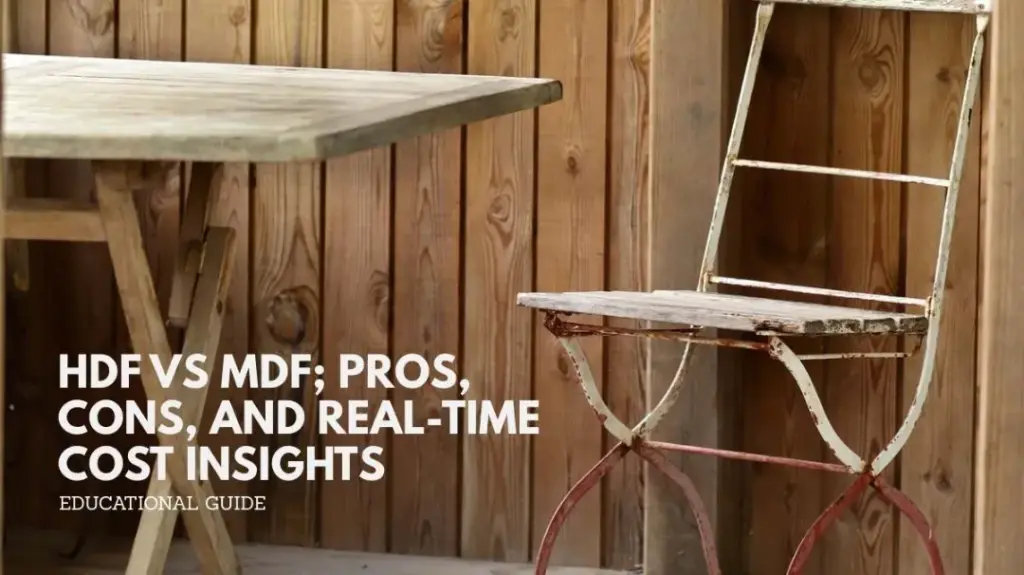
HDF VS MDF; PROS, CONS, AND REAL-TIME COST INSIGHTS
There are many options in the market for different kinds of wood, such as MDF (medium-density fibreboard), MFC (melamine-faced chipboard), plywood, and HDF (high-density fibreboard). Each material is unique in its own way, with different purposes, costs, and benefits.
It is essential to know the differences between these materials so that you can understand their various uses.
This article will compare two of these materials, high-density fiberboard and medium-density fiberboard bringing to light their pros, cons, and real-life cost insights.
Table of Contents
| Feature | HDF (High-Density Fibreboard) | MDF (Medium-Density Fibreboard) |
|---|---|---|
| Density | ~900 kg/m³ | 680–730 kg/m³ |
| Strength & Durability | Very strong and durable; withstands impact and wear | Less durable; prone to dents and sagging under heavy loads |
| Typical Thickness | 3mm – 8mm | Usually thicker panels available for furniture and cabinets |
| Cost | Higher cost: ~$10–$20 per sheet | Lower cost: ~$5–$10 per sheet |
| Workability | Harder to cut and shape; requires stronger tools | Easy to cut and shape with standard tools |
| Common Uses | Laminate flooring, door skins, underlayment, high-traffic areas | Furniture, shelving, decorative panels, cabinetry |
| Moisture Resistance | More moisture-resistant when sealed | Poor moisture resistance; absorbs water easily |
What Is HDF
HDF refers to High-Density Fibreboard, which is an engineered wood manufactured from compressed wood fibres. The compressed density stands at 900kg/m³, which makes it stronger than MDF (medium-density fibreboard).
This level of density makes it especially suitable for laminate flooring products, among many other uses such as door skins and underlayment.
The thickness of HDF stands between 3mm and 8mm.
Pros and Cons of HDF
Pros
Durability
One of the major advantages of HDF is its durability and strength. With a superior density of approximately 900kg/m³, it has the strength to withstand impact, dents, and wear in high-traffic areas of the home, such as kitchen cabinets or flooring. This makes it a strong option, as it stands the test of time without wearing off due to impact.
Stability
Since it is majorly used for flooring, which can be affected by unfavourable weather, it is a good option because it is less prone to warping, swelling, or cracking due to temperature changes.
Smooth Surface
HDF is a perfect option for painting, laminating, and veneers because of its uniform texture, which enables precise detailing. An example is shaker doors.
Moisture Resistance
HDF is very good for use in areas such as kitchens and bathrooms. It is resistant to moisture when properly sealed and also provides good sound insulation for multi-story homes.
Cons
Higher Cost
HDF costs more than MDF. A rough estimate is between $10 and $20 per sheet, making it more expensive and having a higher impact on project budgets.
Workability
HDF is hard to work with and requires sharper and stronger tools to cut and shape. Because of its compressed fibres, it demands more effort, yet it does not chip away during cutting.
Weight
HDF is usually heavier than MDF because a large amount of fibreboard is compressed together. This makes it require strong support during transportation, handling, and installation.
Not Fully Waterproof
While it is moisture-resistant, it cannot withstand prolonged exposure to water, especially when it is not fully sealed. When damaged, it requires full replacement, as it cannot be repaired.
What Is MDF
MDF (medium-density fibreboard) is an engineered wood product made from high-temperature wood fibres combined with resin and wax, which are then pressed into dense panels.
The compressed density stands within the range of 680kg/m³ to 730kg/m³.
It consists of 82% wood fibres, 9% urea-formaldehyde resin, 8% water, and 1% paraffin wax.
Pros and Cons of MDF
Pros
Price
The price of MDF is lower than that of HDF, with a rough estimate of $5 to $10 per sheet, making it affordable. This also makes it a good choice for large-scale projects such as furniture and shelving.
Better Workability
MDF is easy to work with, as cuts and shapes can be made easily using standard tools. This allows for clean cuts with smooth edges, making it ideal for intricate designs, mouldings, and cabinet styles without much splintering.
Smooth Surface
Like HDF, MDF has a naturally smooth surface and a texture suitable for paints, stains, laminates, and veneers. This makes it a perfect choice for painted finishes in prototypes and decorative elements.
Lightweight
Since MDF does not have as much compressed fibreboard as HDF, it is lighter in weight, making it more mobile, easier to manoeuvre, and suitable for solo installation.
Cons
Limited Durability and Strength
MDF is not as durable as HDF. Due to its softer composition, it can easily develop dents, chips, or sagging under heavy loads when used as kitchen cabinets or shelves. It is not suitable for high-impact flooring or heavily used tabletops.
Poor Moisture Tolerance
MDF absorbs water easily, which causes swelling and warping in unfavourable conditions such as humid environments. The best way to reduce this issue is for it to be thoroughly sealed.
Health Safety
During work, MDF generates a lot of dust and fine particles when cutting, which makes it necessary to wear protective masks. It also contains formaldehyde, which may off-gas indoors.
Repair Challenges
Since MDF is not the best option in terms of durability, when a section is damaged, repairs are almost impossible. It often requires full replacement of the affected parts.
Conclusion
Using either HDF or MDF in your wood projects depends on your priorities. HDF is suitable for projects that require durability and strength, although the scale of the project must be considered because it is more costly than MDF. HDF is best for high-traffic areas such as kitchen cabinets or large libraries. MDF is a good choice for budget-friendly projects, such as hobbyist carpentry work, and for projects that prioritise ease of shaping.
Related: Read on the 5 key differences between hardwood and softwood
HDF vs MDF Frequently Asked Questions
What’s the main difference between HDF and MDF?
Density. HDF (High-Density Fiberboard) packs wood fibers at 800-1000 kg/m³, making it harder, stronger, and more moisture-resistant. MDF (Medium-Density Fiberboard) sits at 600-800 kg/m³, making it lighter and easier to cut and shape. HDF costs more but performs better in flooring and high-stress applications; MDF is the go-to for cabinets, shelving, and trim.
Is HDF or MDF better for furniture?
MDF wins for most furniture because it’s easier to work with, takes paint beautifully, and costs less. HDF is better for high-stress furniture like desks with weight loads or pieces in semi-humid areas (bathrooms, basements). Use HDF for tabletops and shelves that hold heavy items; use MDF for cabinet boxes, drawer fronts, and decorative trim.
Can HDF or MDF get wet?
Both are vulnerable to moisture, but HDF resists water better than MDF. Standard MDF will swell, bubble, and fail with even brief water exposure. HDF can handle splashes and humidity better, especially when sealed. For wet areas, look for moisture-resistant (MR) versions or marine-grade plywood, which both significantly outperform standard fiberboard.
Is HDF more expensive than MDF?
Yes, typically 30 to 60 percent more. A 4×8 foot sheet of standard MDF runs $25 to $40, while comparable HDF runs $40 to $65. Premium HDF used in laminate flooring can hit $80+ per sheet. The price gap reflects HDF’s manufacturing process, denser raw material use, and superior moisture and impact resistance.
Are HDF and MDF safe to use indoors?
Modern HDF and MDF made in the US, EU, or Canada meet CARB Phase 2 or TSCA Title VI formaldehyde emission standards, making them safe for indoor use. Older or imported boards may emit higher VOCs. Look for GREENGUARD or NAUF (no added urea formaldehyde) certifications, and ventilate the space well when cutting either material since dust and fumes can irritate.
Pressed Wood Vs Real Wood: Which One is Right for You?

Does Wooden Furniture Absorb Water? Everything You Need To Know

Why Is Walnut The Best Wood For Kitchen Utensils?

8 Best Wood For Cutting Boards
The Great Debate: Acacia Wood Vs. Teak Wood For Cutting Boards!

Stone Cutting Boards: Pros, Cons, And Best Uses
Loved by our customers


Wooden Utensil Holder
Wood Cutting Boards
Walnut Wooden French Bread Slicer for Baguettes, 1 inch thick slices
Living Room